
Thales of Miletus: The father of Western Philosophy
A short exploration of the first philosophers philosophy.

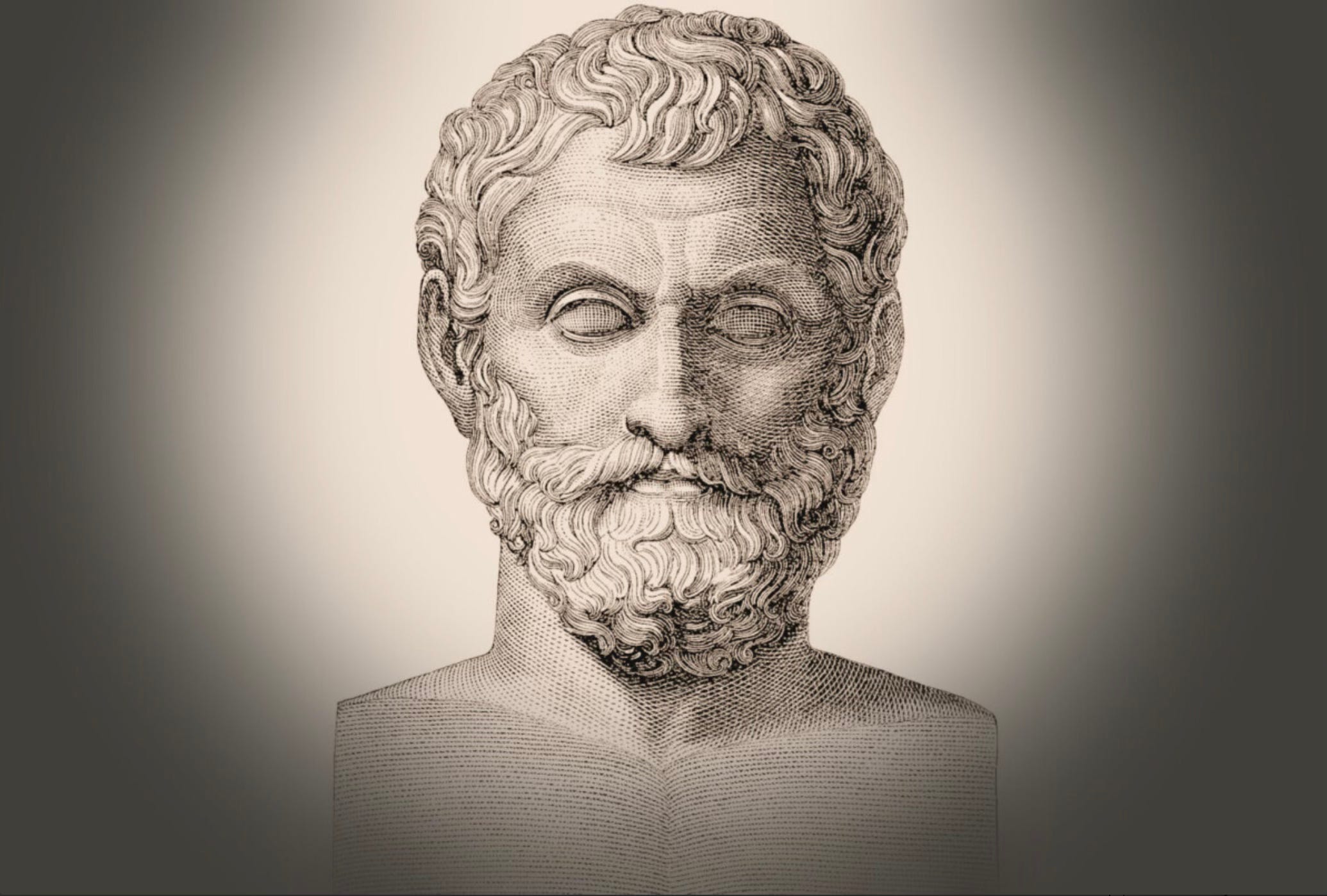
Thales of Miletus was born around 625BCE in Miletus (Ionia) which is now in the western coast of Turkey. He was part of what is referred to as the ‘Milesian School’, a school of thought consisting of himself (Thales), Anaximander, and Anaximenes, who were all from Miletus. It is important to note here that only fragments and paraphrases by other authors remain; often containing the authors own agenda (i.e., Aristotle or Diogenes Laertius). Thales is often pinpointed as the first person to investigate the causes and principles of the natural world, and hence is the founder of natural philosophy (moving away from supernatural or mythological accounts). He is also attributed to being one of the first astronomers and mathematicians, having calculated the sun’s approximate angular size correctly. There are also many claims about him predicting solar eclipses accurately, but these lack basis. To summarise, he was multi-talented, and had his hands in many things.
So why should one learn about him, and why is he important? To put simply, the shift away from mythological accounts in the Ancient Greek world is incredibly significant. It reveals how early thinkers moved toward naturalistic understanding and practical wisdom. His ideas indirectly led to the development of Plato’s thought, and through Plato, Aristotle. This causal chain continues until the modern age. Without Thales, western society may have developed towards a completely different direction. He is a foundational figure of western thought, and crucial to understanding the history of philosophy.
D4 (≠ DK) (Ps.-?) Hippolytus, Refutation of All Heresies
[. . .] He said that the beginning of everything and its end is water. For it is out of this that all things are formed, when it solidifies and liquefies in turn, and all things rest upon it, and it is also from this that earthquakes, concentrations of winds, and the motions of the stars come [...].
The Milesians primarily concerned themselves with the nature of matter and matters transformation into the infinite things of which the world consists of. Thales argued that the first principle (archê) is water. He believed that water is the nature of all things and everything’s origin (monism). But why water? Thales could easily observe that water is present everywhere; from the oceans to the moisture in living things. Water can be found in three states: ice, vapour, liquid. Life comes from water, and it was possible for Thales to witness earth generating from water. The naive claim that the earth floats on water is also attributed to Thales.
Thales was thus an empiricist. He observed nature and made claims based on evidence. But Thales himself would not have referred to himself this way, as empiricism was not a concept during his time.
(DK11 A22 = LM5 D10, R34a; Aristotle, On the Soul 1.5 411a7–8)
Some people say that it [i.e. the soul] is mixed in with the whole, which is perhaps also the reason why Thales thought that all things are full of gods.
(DK11 A22 = LM5 D11a; Aristotle, On the Soul 1.2 405a19–21)
Thales too seems, from what is reported, to have thought that the soul is something that moves, for he says that the stone [i.e. the magnet] has a soul, given that it moves iron.
According to Aristotle, Thales also held the belief that all things are full of gods. What is meant by this? Thales observed that a stone (magnet) could move iron without any external force placed upon it. For Thales this could be interpreted as being self-instantiated movement, which requires a soul (animating principle). If an insignificant object such as a stone has a soul, it is easy to make the leap that everything in the universe must contain a soul. Microcosm to macrocosm. Because the entire universe is permeated by this same life-giving divine animating principle, therefore, all things are full of gods.
As stated earlier, only fragments of Thales remain. So we do not know much about his thought and I have summarised everything significant that remains. We may consider some of his ideas as primitive, but for his time, voicing such thoughts and opinions was incredible. Many of his indirect followers would face persecution and struggle against their respective societies, yet he was still considered as one of the seven sages of Greece during Plato’s time.
Thales was the first, and Anaximander followed in his footsteps, and Anaximenes in Anaximanders.. With each, a major leap in thought occurred. It is easy to dismiss each of their respective accounts as primitive, but their significance in the development of humanity is not to be understated.
References:
A. Laks and W.G. Most (eds. and trans.), Early Greek Philosophy, vol. II (Cambridge MA., Loeb Classical Library, 2016) - all direct quotes are from here.
https://iep.utm.edu/thales/
Curd, Patricia, “Presocratic Philosophy”, The Stanford Encyclopedia of Philosophy (Fall 2023 Edition), Edward N. Zalta & Uri Nodelman (eds.), URL = <https://plato.stanford.edu/archives/fall2023/entries/presocratics/>.
Shaul Tor Lecture Notes - great professor
Warren, James. Presocratics, Taylor & Francis Group, 2007